The global need for efficient separation technologies is paramount, impacting industries ranging from power generation and manufacturing to environmental protection and resource recovery. cyclone separator systems are a cornerstone of this effort, offering a cost-effective and reliable solution for removing particulate matter from gas streams. Their widespread adoption is fueled by increasingly stringent environmental regulations and the demand for cleaner, more efficient industrial processes.
In numerous industrial applications, maintaining product quality and protecting equipment from wear and tear necessitates effective particle separation. Cyclone separators provide a simple yet powerful method to achieve this, reducing downtime, improving operational efficiency, and ultimately boosting profitability. The technology's scalability and adaptability make it suitable for both small-scale operations and large-scale industrial complexes.
Understanding the principles and applications of cyclone separators is, therefore, crucial for engineers, environmental professionals, and anyone involved in industrial processes where particle separation is a critical requirement. This knowledge empowers informed decision-making, leading to optimized performance, reduced costs, and a more sustainable industrial landscape.
The Core Principles of cyclone separator
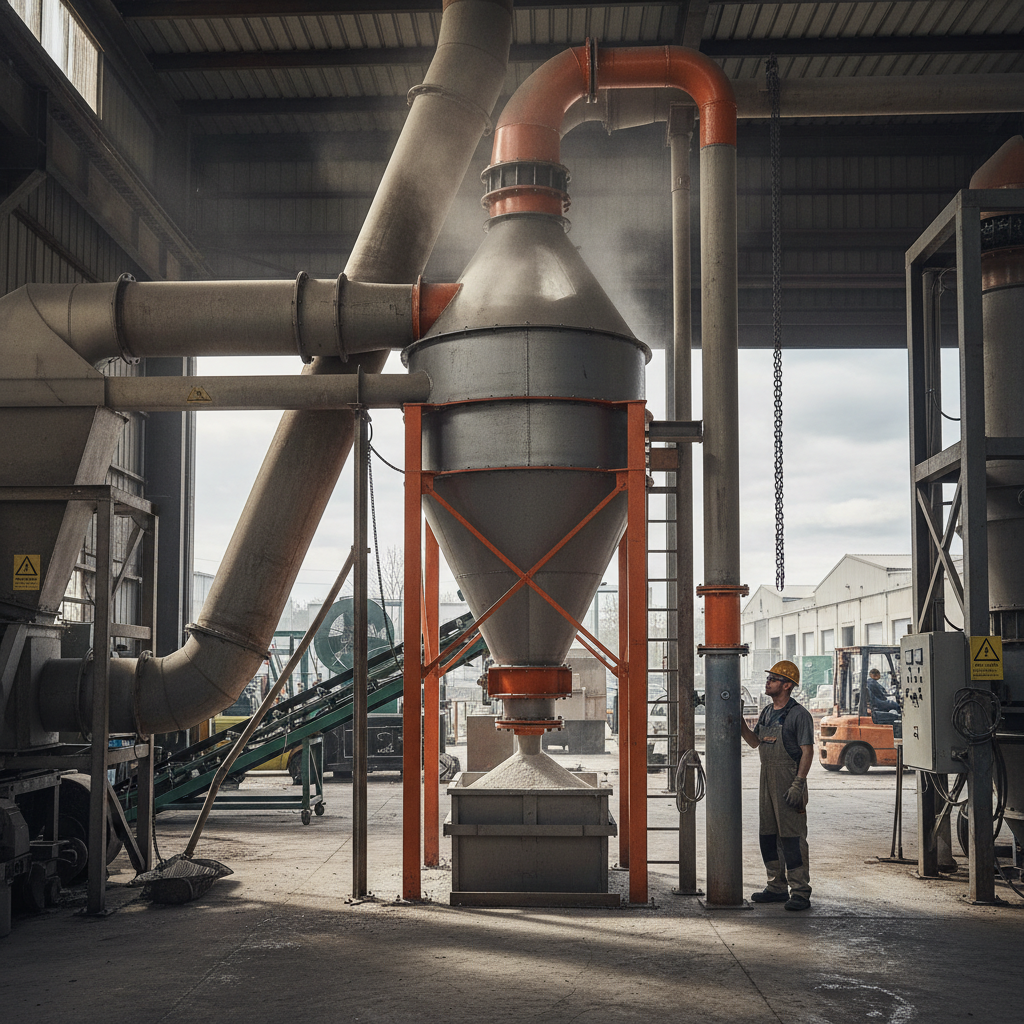
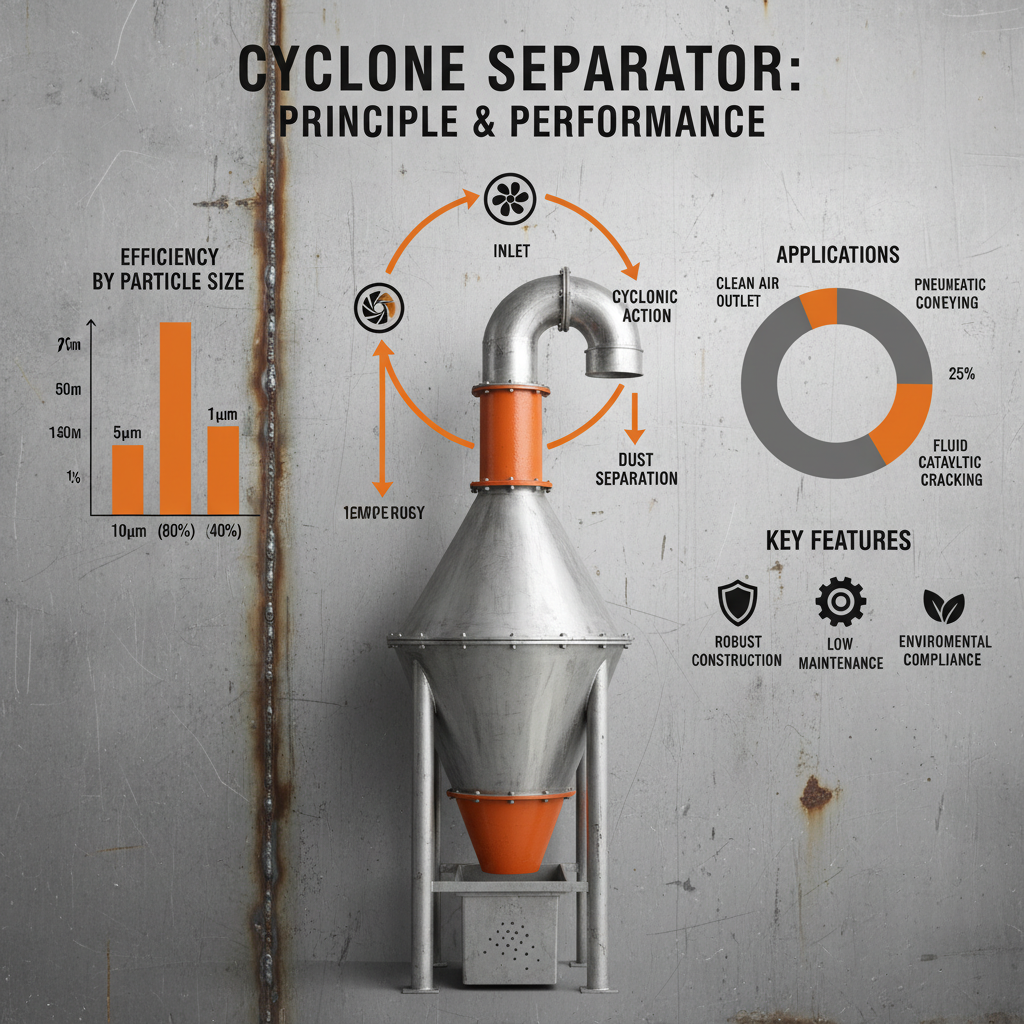
At its heart, a cyclone separator leverages centrifugal force to separate particulate matter from a gas stream. The gas is introduced tangentially into a conical or cylindrical chamber, creating a swirling vortex. Heavier particles are flung outwards towards the walls of the cyclone and spiral down into a collection hopper.
The efficiency of this process is dictated by several factors, including the cyclone's geometry, the gas flow rate, and the particle size distribution. Optimizing these parameters is crucial for achieving maximum separation efficiency and minimizing particle carryover. Properly designed cyclone separators can handle large volumetric flow rates with minimal pressure drop.
Global Relevance and Industry Impact
The demand for cyclone separators is globally driven by increasingly stringent environmental regulations aimed at reducing particulate emissions. Industries like power generation, cement production, and mining are particularly reliant on this technology to comply with air quality standards set by organizations like the EPA and the European Environment Agency.
The World Bank estimates that air pollution costs the global economy trillions of dollars annually in healthcare expenses and lost productivity. Cyclone separators play a critical role in mitigating this economic burden by removing harmful particulate matter from industrial exhaust streams, contributing to cleaner air and improved public health.
Furthermore, the use of cyclone separator technologies extends beyond environmental compliance. They are essential for protecting sensitive equipment in various industrial processes, preventing abrasion, and maintaining product purity, leading to increased operational efficiency and reduced maintenance costs.
Defining cyclone separator Technology
A cyclone separator is a static, dry particle separation device, meaning it doesn't employ moving parts or require a liquid medium for separation. This simplicity translates to lower maintenance requirements, reduced operating costs, and increased reliability compared to other separation technologies like filters or scrubbers.
The core components typically include an inlet duct, a conical or cylindrical separation chamber, and a collection hopper. The inlet duct directs the gas stream into the chamber creating the vortex. The chamber’s geometry is carefully designed to maximize centrifugal force and particle collection efficiency. The collection hopper allows for easy removal of the separated particulate matter.
Modern cyclone separators are often incorporated into larger air pollution control systems, acting as pre-cleaners to remove larger particles before more sophisticated downstream equipment. This approach extends the lifespan and efficiency of these downstream components, resulting in further cost savings.
Key Factors Influencing cyclone separator Performance
The performance of a cyclone separator is determined by several key factors. One crucial aspect is the cyclone's inlet velocity – a higher velocity generally leads to greater centrifugal force and improved separation, but can also increase pressure drop. Finding the optimal balance is paramount.
Another critical factor is the particle size distribution of the gas stream. Cyclone separators are most effective at removing larger particles (typically above 10 microns), while smaller particles may require supplemental filtration. The cyclone’s geometry (cone angle, diameter) also significantly influences its separation efficiency.
Real-World Applications of cyclone separator
cyclone separators are integral to a wide range of industrial applications. In coal-fired power plants, they are used to remove fly ash from flue gases, protecting downstream equipment and reducing air pollution. In the cement industry, they capture dust generated during the grinding of raw materials.
The technology also finds application in wood processing, where it removes sawdust and wood chips from exhaust air streams, improving air quality and preventing fire hazards. Moreover, cyclone separators are used in grain handling and processing to remove chaff and other impurities.
Advantages and Long-Term Value Proposition
The advantages of employing cyclone separators are numerous. Their simple design translates to low capital costs, minimal maintenance, and high reliability. They operate without moving parts, reducing the risk of mechanical failure and extending service life.
Beyond cost savings, cyclone separators contribute to a more sustainable industrial practice by reducing particulate emissions and protecting the environment. Their efficiency in removing abrasive particles also extends the lifespan of downstream equipment, further enhancing their long-term value proposition.
Future Trends and Innovations in cyclone separator
Ongoing research and development efforts are focused on improving the efficiency and performance of cyclone separators. This includes optimizing cyclone geometries using computational fluid dynamics (CFD) modeling and exploring novel materials with enhanced wear resistance.
The integration of cyclone separator systems with advanced monitoring and control systems is another emerging trend, allowing for real-time optimization of performance and predictive maintenance. Further research is also geared towards enhancing the ability to capture ultra-fine particles, expanding the scope of applications.
Digital twins and AI-powered analytics are poised to revolutionize the operation and maintenance of cyclone separator systems, driving greater efficiency, and reducing operational costs within industries.
Summary of Factors influencing cyclone separator
| Factor |
Description |
Impact on Performance |
Optimization Strategies |
| Inlet Velocity |
The speed at which the gas enters the cyclone. |
Higher velocity increases centrifugal force but also pressure drop. |
Optimize to balance separation efficiency and pressure loss. |
| Cyclone Geometry |
Cone angle, diameter, and overall shape of the cyclone. |
Influences vortex formation and particle collection. |
Utilize CFD modeling for optimal design. |
| Particle Size Distribution |
The range of particle sizes present in the gas stream. |
Affects collection efficiency, especially for fine particles. |
Combine with upstream filters or downstream scrubbers. |
| Gas Flow Rate |
The volumetric flow rate of the gas stream. |
Affects residence time and separation efficiency. |
Maintain optimal flow rate for effective separation. |
| Gas Viscosity |
The resistance of the gas to flow. |
Higher viscosity reduces separation efficiency. |
Consider temperature effects on viscosity. |
| Material of Construction |
The materials used to build the cyclone separator. |
Affects wear resistance and corrosion protection. |
Select materials appropriate for the application. |
FAQS
Cyclone separators are most effective at removing particles larger than 10 microns in diameter. While they can capture some smaller particles, their efficiency decreases significantly below this size. For capturing finer particles (PM2.5, PM10), it’s common to combine cyclone separators with downstream filtration systems like baghouses or electrostatic precipitators. Selecting the right combination depends on the specific particle size distribution and required collection efficiency for your application. Understanding the target particulate matter is key to optimizing the system’s performance.
The pressure drop across a cyclone separator typically ranges from 2 to 10 inches of water gauge (in. wg). This value is influenced by factors like inlet velocity, cyclone geometry, and gas properties. Higher velocities generally result in lower pressure drop, but also reduce separation efficiency. Optimizing the design to balance these factors is crucial. Accurately predicting pressure drop is essential for proper fan sizing and system performance calculations.
Cyclone separators generally require minimal maintenance due to their simple design and lack of moving parts. Routine inspections should be conducted to check for wear and tear on the internal surfaces, particularly in areas exposed to abrasive particles. Regularly emptying the collection hopper is essential. Depending on the application, occasional cleaning of the cyclone body may be required to remove accumulated deposits, ensuring continued optimal performance and avoiding blockages.
Yes, cyclone separators can be designed to handle high-temperature gas streams. However, careful material selection is crucial to ensure the structural integrity and corrosion resistance of the separator. Materials like carbon steel or high-temperature alloys are commonly used in these applications. Proper insulation may also be necessary to prevent heat loss and maintain process temperatures.
A single cyclone separator is a standalone unit, while a multi-cyclone system consists of multiple smaller cyclones arranged in parallel. Multi-cyclone systems are generally more efficient at capturing fine particles and handling larger gas volumes compared to single cyclones. They distribute the gas flow across multiple cyclones, reducing the load on each individual unit and improving overall performance. They offer a better cost-benefit ratio for large-scale industrial applications.
While effective for larger particles, cyclone separators have limitations in capturing very fine particles (less than 2.5 microns). They are also less efficient with gases containing low-density particles or sticky materials that can adhere to the cyclone walls. In these cases, supplemental pollution control technologies, such as baghouses, scrubbers, or electrostatic precipitators, are often required to achieve desired emission levels. The effectiveness also depends on stable gas flow rates.
Conclusion
In conclusion, cyclone separators represent a robust, cost-effective, and environmentally responsible solution for particle separation across a diverse range of industries. Their simple design, minimal maintenance requirements, and ability to handle large gas volumes make them a valuable asset in optimizing industrial processes, reducing emissions, and protecting equipment. Understanding the fundamental principles and key influencing factors is crucial for maximizing their performance and achieving desired results.
Looking ahead, continued innovation in cyclone design, coupled with the integration of advanced monitoring and control systems, promises to further enhance their efficiency and adaptability. By embracing these advancements, industries can leverage the power of cyclone separators to build a more sustainable and efficient future. Visit our website at www.gasouyinuo.com to learn more about our solutions.